1,647 Domain Reseller Reviews: What Do Resellers Want?

Picture a hosting company managing roughly 800 domains. One morning a customer calls: "My email is down." At first glance it looks like a hosting failure. The technical team spends hours checking servers. That's not where the problem is. The real issue is a single domain that quietly expired three days earlier and nobody noticed. At that moment, the story stops being about a three-dollar renewal fee — it becomes about customer trust, company reputation, and a full day of lost business.
This report is an independent industry research note prepared by a team working in domain infrastructure and reseller services.
Domain reseller programs are usually compared on the same four things: price, number of supported extensions, API features, and white-label capability. When a provider offers a cheaper ".com" price or supports more extensions, it's assumed that automatically makes it the better choice for resellers. Nearly every "best domain reseller program" roundup on the web never goes beyond ranking those same four factors.
We took a different approach. We reviewed public Trustpilot profiles and standout user feedback across nine domain reseller and registrar infrastructure providers, covering a combined total of 1,647 user reviews, spanning ratings from 1.7 to 4.7 out of 5. Our goal wasn't to rank who's cheapest. It was to understand what resellers actually care about when choosing a provider, staying with one, or leaving one.
Domain resellers aren't just buying domain names. They're buying reliability, business continuity, accessible support, and predictable operations.
Why We Did This Research
As a team working in domain infrastructure, we talk to hosting companies, web agencies, and software businesses every day. In support requests and sales conversations, we kept hearing the same three questions: "Which reseller program is cheapest?", "Whose API is the best?", "Does price matter more than support?" Instead of answering from our own experience, we decided to look at real user experiences across the industry and find a data-backed answer. This research is that answer.
5 Standout Findings From This Research
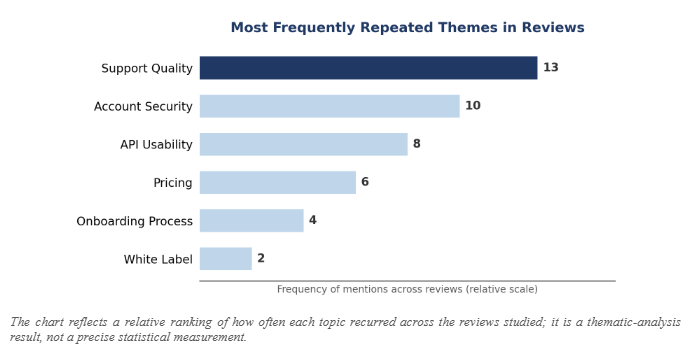
These five findings summarize the thematic distribution across 1,647 reviews, and as the chart below shows, they reflect how often each topic recurred in the reviews we studied. Support quality is by far the most discussed topic; white-label branding is a feature providers push hard in marketing but users almost never mention in their reviews.
Research Scope and Methodology
The providers studied ranged from major players with well over a thousand reviews to smaller providers with only a few dozen. That range matters: it shows the findings aren't specific to one business model or price segment, but reflect recurring behavior patterns across the industry as a whole.
Methodologically, standout and high-engagement reviews from each platform were coded thematically around five categories: pricing and hidden fees, support quality and response speed, technical reliability (uptime, transfer, renewal), account security and transparency, and the onboarding/setup process. Claims made in reviews were treated as subjective user experience and perception, not independently verified facts — a distinction we maintained throughout this research.
Note: No specific provider is named directly in this article; findings are presented as recurring patterns across platforms.
Limitations of This Research
This study covers only publicly available reviews on Trustpilot; other feedback channels such as support tickets, phone calls, or providers' internal satisfaction surveys were outside its scope. Reviews reflect subjective user opinion and are not independently verified, so they may not represent a provider's entire customer base. The likelihood of leaving a review on Trustpilot can also vary across user groups — so these findings should be read as thematic tendencies, not precise statistical measurements.
Price Matters, But It's Not Enough on Its Own
Across the 1,647 reviews we studied, the split between positive and negative experiences wasn't primarily a price split — it was more often about support and reliability; that said, it would be unrealistic to claim price is irrelevant in domain reselling, since resellers manage domains at volume, where even a few cents of difference affects total cost. Still, the reviews clearly show that offering the lowest price doesn't guarantee satisfaction on its own: low perceived pricing did not reliably translate into high satisfaction, and some of the more competitively priced providers still carried serious dissatisfaction themes.
The real cost of a domain reseller program isn't just the registration price. Resellers weigh renewal fees, transfer fees, post-deletion restore charges, payment processing costs, balance top-up conditions, and the potential cost of outages or errors — all together. A cheap registration fee loses its meaning the moment a domain can't be renewed because support is unreachable, since that can take down a customer's website or email and put the reseller's own client relationship at risk.
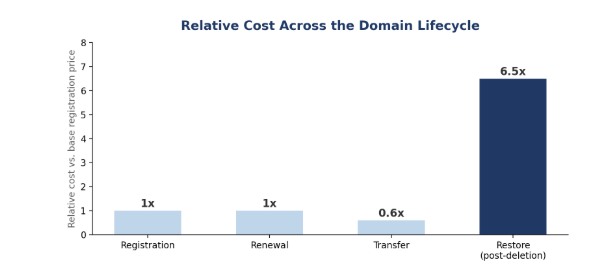
The practical takeaway is clear: showing only a promotional registration price on a pricing page isn't enough. Presenting resellers with a full lifecycle cost table builds more trust than emphasizing a low price alone.
Support Isn't an Add-On — It's Part of the Product
The strongest and most consistent theme in this research was customer support. On the highest-rated platform, most positive reviews praised the support team directly — not API capacity, TLD count, or panel design — often naming a specific staff member and describing a problem solved in a single conversation.
On the other end, the most common complaints in low-rated reviews were unanswered tickets, having to repeat the same information multiple times, issues being bounced between teams, and no clear resolution timeline being shared. Even some higher-priced providers weren't immune to these complaints — meaning price level was not a guarantee of support quality.
The reason is simple: a failure at a domain reseller provider doesn't just affect the reseller — it affects the reseller's own customer too. If a domain isn't renewed in time, a customer's site can go down; if a nameserver change fails, service can be interrupted; if a transfer is delayed, a project deadline can slip. That's why support quality isn't a bolt-on service — it's a direct component of product quality.
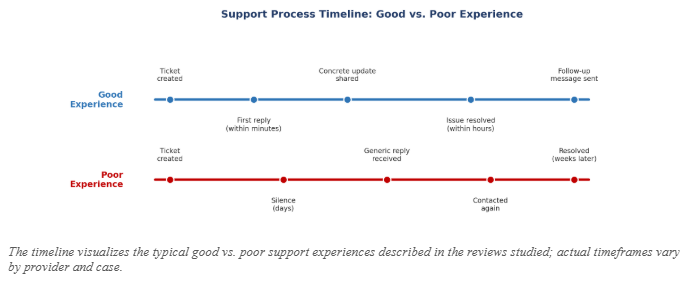
Two representative examples capture this tonal divide seen across the reviews — one reflecting satisfaction, the other frustration:
"Support fixed my issue within minutes." / "I waited weeks for a response."
First Response Time and Resolution Time Are Not the Same Thing
A support team can reply to a ticket within five minutes — but if that reply only says "your request has been forwarded to the relevant team," the issue isn't resolved from the customer's perspective. Reviews clearly showed this distinction: a fast but content-free first reply, followed by days of silence, was a recurring source of frustration.
Two separate metrics need to be tracked together: first response time and actual resolution time. A third metric should be added as well — how often the customer receives meaningful, concrete updates while an issue remains unresolved. "Your ticket has been forwarded to our technical team" and "Your renewal request is being rejected by the registry; our technical team is reviewing the error code and will share an update within two hours; your DNS service remains active in the meantime" are not the same message. The second reduces uncertainty and signals that the process is under control, even before the technical issue is actually fixed.
Resellers Buy Business Continuity, Not Domain Names
A domain registration itself can technically complete in seconds — but the relationship between a reseller and its infrastructure provider lasts for years. What a reseller actually needs is for registration, renewal, transfer, nameserver management, and API access to work predictably. A modern panel or a feature-rich API means little if critical operations don't complete reliably.
Among the reviews studied, cases describing a domain unexpectedly turning up registered elsewhere after a search, or a domain becoming inaccessible for an extended period during a lock/redemption process, stood out. Whether or not each claim is independently verified, this kind of story shows just how fragile trust can be in the registrar industry. A reliable provider should offer a public status page, scheduled maintenance notices, detailed transaction logs, and estimated resolution times for critical issues.
The First Week Decides Whether a Customer Stays
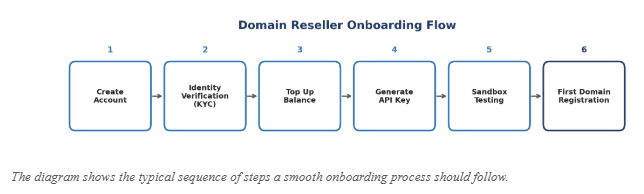
Opening a new reseller account is the start of a long-term relationship — yet at many providers, onboarding amounts to little more than a signup form and a verification email. In reality, a new reseller has to get through account verification, identity/company verification (KYC), an initial balance top-up, API key generation, automation-panel setup (WHMCS/WISECP-style), and a first domain registration. If any single step is unclear, a customer can walk away in the first few days — often without ever explaining why.
The contrast across reviews was striking: some described onboarding processes that dragged on for months, unable to complete even a basic payment integration, while others described identity verification resolved in minutes with step-by-step setup support. That contrast shows onboarding isn't just a technical formality — it's a commercial process that directly determines churn or loyalty. The right success metric isn't "was the account opened," but "how long did it take the reseller to complete their first successful domain transaction."
A Strong API Isn't Enough — It Has to Be Usable
Most providers claim to offer an API, but for a developer, "we have an API" isn't sufficient on its own. Nearly every positive mention of an API in the reviews appeared in the context of a completed, specific task — often crediting a support agent who helped with the integration. That means even a technically strong API can look "bad" to a new reseller if it's paired with thin documentation or unclear error handling.
A usable domain API needs up-to-date documentation, a sandbox/test environment, real request-response examples, descriptive error codes, and rate-limit information. Technical quality only becomes visible once onboarding is successfully completed — which explains why the real breaking point tends to be the onboarding process, not API design itself.
Error Messages Are Part of the Experience Too
A message like "registration failed" may be technically accurate, but it doesn't tell the customer what to do next. A good error message should answer what happened, why the transaction failed, whether the balance was affected, whether it can be retried, and what error code to report to support.
Account Security Is the Foundation of Trust in This Industry
Domains aren't just digital assets — a business's website, email, and brand identity depend on them. That's why claims involving unauthorized nameserver changes, lost account access, a domain moved to another account, or an account suspended without clear justification are especially sensitive. Regardless of whether each individual claim is verified, this kind of review shows how severely a security incident can damage reputation on a public review platform.
This is why enterprise-grade security tooling should now be standard: two-factor authentication, IP-based API restrictions, user roles, session history, and additional verification for high-risk actions. Letting a reseller see who made a change, when, from which IP, through which channel, and what exactly changed — directly from the panel — both improves security and shortens support resolution time.
The same sensitivity applies to suspension and abuse-handling processes. Restrictions are sometimes unavoidable — due to identity verification, payment risk, or legal requests — but the problem isn't the restriction itself; it's the customer not understanding why it happened or how to resolve it. Without a clear explanation of what action was taken, why, what's required to resolve it, and how to appeal, even a correct policy can feel arbitrary or unfair.
Panel Aesthetics Don't Drive Sales — But a Broken Panel Drives Customers Away
Panel design was rarely praised directly in positive reviews — because a well-functioning panel is simply taken as the expected baseline. But when the panel breaks, the impact is disproportionate: reports of core functions failing, or problems with payment or management screens, showed up even on otherwise highly rated platforms.
This clarifies what should actually be prioritized in reseller panel design: correct transaction completion, clear status visibility, understandable error explanations, and consistent performance — all ahead of visual design. Aesthetics matter, but usability and operational correctness matter far more on a reseller platform.
What Resellers Are Really Buying: Recurring Revenue, Automation, and Brand Control
Nearly every provider studied describes itself the same way: a "domain reseller program" built around TLD count, API access, and white-label capability. Almost none of them speak directly to the business outcome the reseller is actually trying to achieve.
That's because resellers aren't in this to sell domains. Hosting companies, web agencies, software businesses, and digital marketing agencies entering this space are typically trying to earn more from existing customers, turn a one-time project into recurring annual revenue, automate manual work, and grow the value of their own brand. White-label is offered as a feature in this context, but the real need is hidden in a single sentence: "I want to face my customer under my own brand — and keep control of that relationship."
A domain reseller program's real value proposition isn't "cheaper domains" — it's "serve your customers under your own brand, automate operations, and grow recurring revenue."
Which Approach Fits You? A Simple Decision Tree
The Trust Index below weighs every criterion and is comprehensive by design — but for a quick sense of direction, a simplified decision tree can help too:
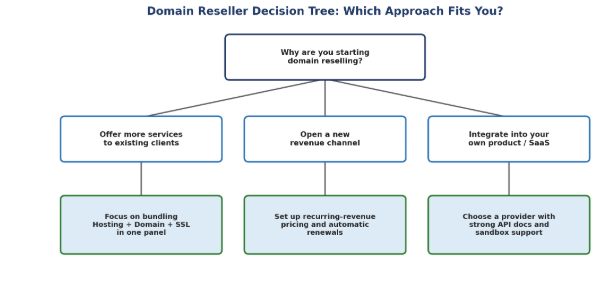
The decision tree summarizes the three most common motivations for becoming a reseller and a general direction for each; it's a starting point, not a definitive recommendation.
Domain Reseller Trust Index 2026
To turn the ten findings above into a single measurable model, we built our own evaluation framework: the Domain Reseller Trust Index. It distributes 100 points across nine weighted criteria; the weights were set based on how often and how severely each topic recurred in this research — which is why support quality and API usability carry far more weight than lower-impact factors like panel aesthetics.
| Criterion | Weight | What to Check |
|---|---|---|
| Support Quality & Response Speed | 20 | First response time, resolution time, and concreteness of communication |
| API Usability | 15 | Up-to-date docs, sandbox environment, clear error codes |
| Price Transparency | 15 | Visibility of registration, renewal, transfer, and restore fees before checkout |
| Account Security | 15 | 2FA, IP restrictions, audit logs, session history |
| System Reliability | 10 | Transparency of outage history, maintenance notices |
| Onboarding Speed | 10 | Number of steps from signup to first successful transaction |
| Balance / Payment Management | 8 | Timing and channel variety of low-balance alerts |
| Restriction Transparency | 4 | Justification and appeal process for suspensions / abuse handling |
| Growth Support | 3 | Brand control, cross-sell options, volume-based terms |
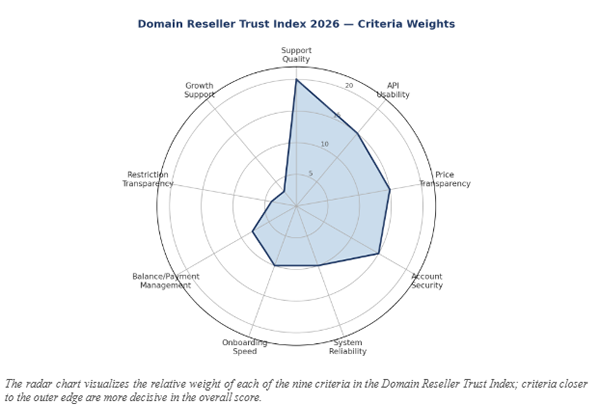
You can use this model to evaluate any domain reseller provider — including the one you're already using. Its purpose isn't to judge one provider against another; it's to make visible what actually matters when choosing one.
10 Questions to Ask When Choosing a Domain Reseller Program
Turning each criterion in the index into a concrete checklist, here are the practical questions worth asking when evaluating a provider:
| # | Criterion | What to Check |
|---|---|---|
| 1 | Price transparency | Are registration, renewal, transfer, and restore fees shown clearly before checkout? |
| 2 | Support response speed | Is a first-response time stated, and does it match what reviews say? |
| 3 | Resolution speed & communication | If an issue can't be solved instantly, are concrete updates provided regularly? |
| 4 | API usability | Is there up-to-date documentation, a sandbox, and clear error codes? |
| 5 | System reliability | Is outage history and maintenance scheduling transparent? |
| 6 | Account security | Are 2FA, IP restrictions, audit logs, and session history offered? |
| 7 | Onboarding speed | How many steps stand between signup and a completed first transaction? |
| 8 | Balance / payment management | Are low-balance alerts timely and sent through multiple channels? |
| 9 | Transparency of restrictions | Are suspension / abuse processes clearly justified with an appeal path? |
| 10 | Growth support | Is there real brand control, cross-selling, and volume-based pricing? |
Frequently Asked Questions
What is a domain reseller program?
A domain reseller program lets a business sell domain names under its own brand. The reseller purchases domains at wholesale rates from a registrar infrastructure provider and resells them to its own customers at its own pricing. It's possible to do this through an existing provider's API or panel without becoming an ICANN-accredited registrar yourself. Hosting companies, web agencies, and software companies commonly use it as both an extra revenue line and a customer-retention tool.
How do I choose the best domain reseller program?
No single criterion is enough. Based on the findings in this research, support response speed, API usability (including documentation and error handling), price transparency, account security, and onboarding speed should all be weighed together. The Domain Reseller Trust Index in this article offers a practical, weighted framework for comparing providers. The lowest price is not, by itself, a sign of the right choice.
Why does the API matter?
APIs automate domain registration, renewal, and transfer. But having an API isn't enough on its own — without up-to-date documentation, clear error codes, and a sandbox environment, it won't be usable for developers. This research found that API quality is usually only noticed after onboarding is already complete.
Is white-label branding necessary?
White-label branding lets a reseller operate under its own name, and it's rarely mentioned directly in reviews. That's not because it's unimportant — it's because it has become an expected baseline. The real need underneath it is control over the customer relationship and the brand itself, which makes white-label capability practically critical for any reseller trying to grow a brand.
Why do hosting companies become domain resellers?
For hosting companies, domain reselling is a way to keep customers on a single platform and turn a one-time service into recurring revenue. If a customer isn't redirected elsewhere for their domain, the hosting company both reduces churn risk and keeps annual renewal revenue in-house.
What's the difference between a domain reseller and a registrar?
A registrar is an organization directly accredited by ICANN or a relevant country authority to officially register domain names. A domain reseller sells domains under its own brand using a registrar's infrastructure, without holding that accreditation itself. Becoming a reseller doesn't require ICANN accreditation, technical infrastructure, or major upfront investment — which makes it far more accessible for most businesses.
Conclusion: The Best Domain Reseller Program Isn't the Cheapest One
The 1,647 reviews examined in this research point to a single conclusion: in the domain reseller industry, customers arrive because of price, but they stay because of reliability and support. A low domain price can get a provider onto a reseller's shortlist — but what determines whether a reseller stays on a platform long-term is whether transactions complete reliably, whether a real expert is reachable when something goes wrong, whether pricing and rules are known in advance, whether the account is secure, and whether customers avoid service interruptions.
A domain reseller service isn't just about sourcing domain names. It's the infrastructure behind the promise a reseller makes to its own customers. Whether you're choosing a new provider or evaluating your current one, testing it against the criteria above will get you a far more reliable answer than a price comparison alone.