cPanel Reseller Hosting Resource Usage and Package Limits Guide
Quick answer
On cPanel Reseller Hosting, resources are managed at three levels: your reseller capacity (total disk, bandwidth and number of accounts), the package you create in WHM (the template of limits for a new customer) and the customer's cPanel account (real usage). Quotas such as disk and bandwidth are defined in cPanel/WHM. CPU, RAM, I/O and Entry Processes aren't cPanel's own limits; if the server runs a resource-control layer such as CloudLinux LVE, they apply per account. When something goes wrong, find out which limit was hit first, fix the application next and consider an upgrade last.
Written by: Domain Name API Hosting Support Team · Technical review: Domain Name API Hosting / Systems Operations Team · Last updated: 5 October 2026 · Sources: official cPanel & WHM and CloudLinux documentation
The screens are representative and use sample data; the real interface can look different depending on your cPanel version and server configuration. Examples use example.com, exampleuser and illustrative package names (Starter, Business, Pro). These packages aren't Domain Name API products; you design your own packages around your service plan.
Know your account first: which limits apply to you?
Before you interpret a limit, you need to know whether that limit is actually enforced on your account. This two-minute check lets you read the rest of the guide correctly.
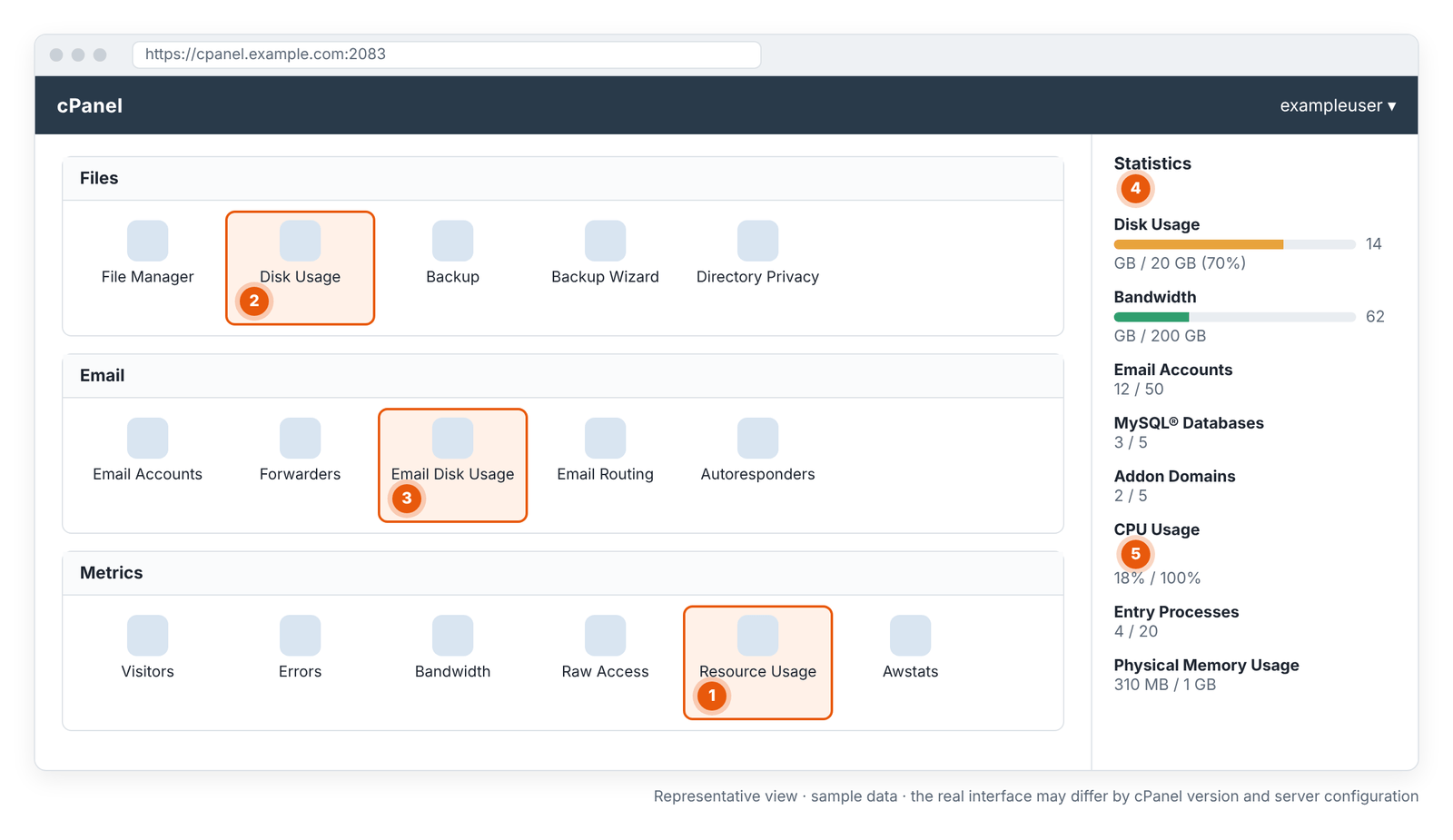
- 1 · Resource Usage: only shown if CloudLinux LVE is in use; CPU, memory, I/O and Entry Processes live here.
- 2 · Disk Usage: disk usage by folder.
- 3 · Email Disk Usage: the space mailboxes take up.
- 4 · Statistics: disk and bandwidth usage plus used/limit values for in-account counts.
- 5 · CPU Usage, Entry Processes, Physical Memory Usage: these rows also only appear when CloudLinux is in use.
- Open a customer account's cPanel (WHM › List Accounts › the cP icon next to the account).
- Look for the Resource Usage icon in the Metrics section.
- If you see Resource Usage: the server runs CloudLinux LVE resource control. The CPU, physical memory, I/O, IOPS, Entry Processes and process count sections of this guide apply to your accounts.
- If you don't: CPU and RAM can't be monitored per account from this screen. Disk, bandwidth and in-account count limits still apply; for performance problems, check the error logs and contact support if needed.
- Find out your reseller capacity (total disk, bandwidth, number of accounts) and your overselling setting from your service details or the support team. The "250 GB" section below explains what that information means.
Resources are managed at three levels: reseller, package, cPanel account
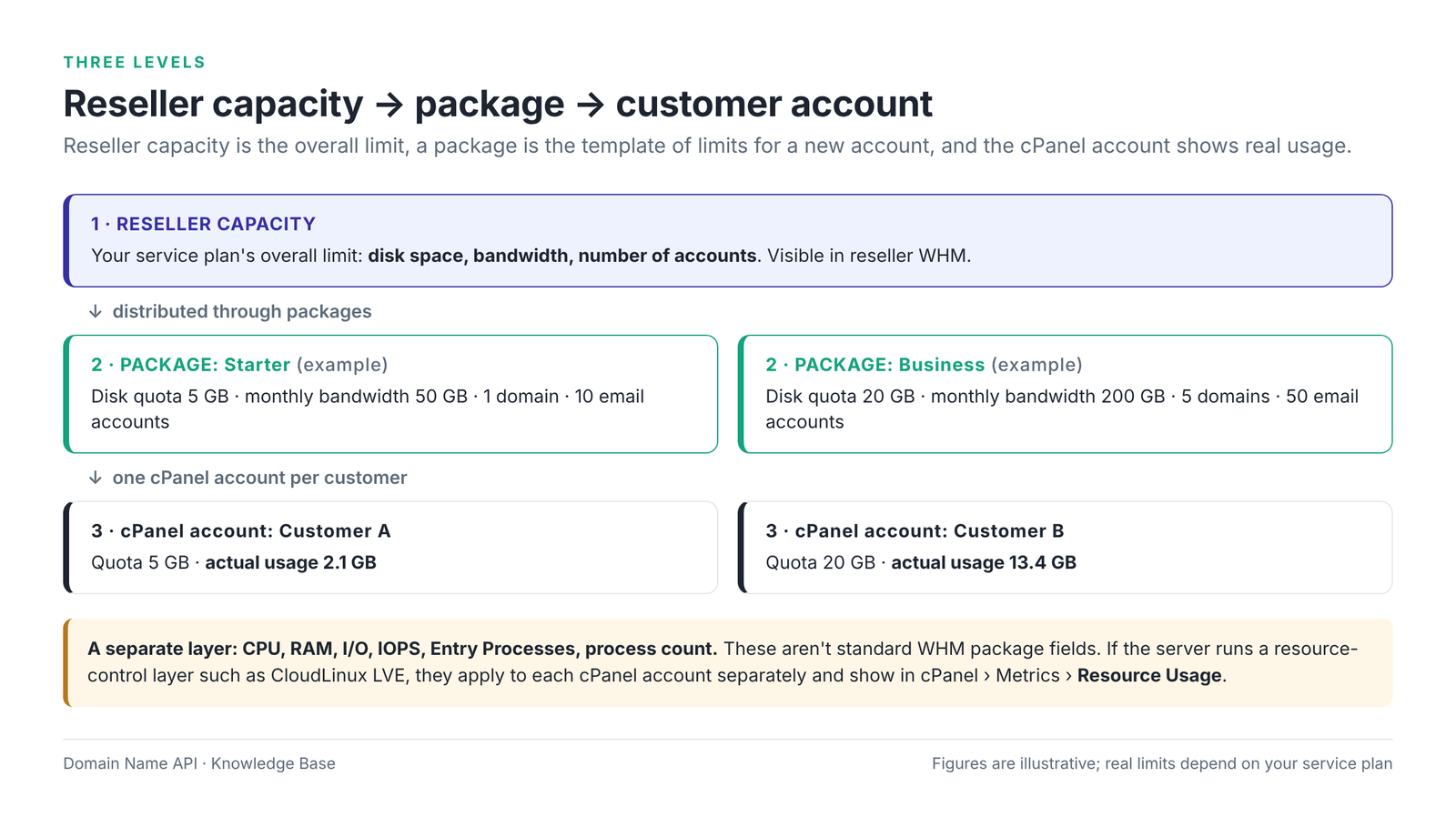
Reseller capacity is your overall limit; a package is the template of limits you give a customer; a cPanel account shows the resources a customer actually consumes. Most resource problems come from mixing these three levels up.
What is reseller capacity?
Reseller capacity is the total limit Domain Name API sets on your reseller account: disk space, monthly bandwidth and the number of accounts you can create. Depending on whether overselling is on or off for your account, this limit applies either to the total of the quotas you allocate to customers or to your accounts' actual usage.
What is a package?
A package is the template of limits you create in WHM › Packages › Add a Package and apply to a new cPanel account: disk quota, monthly bandwidth and the number of domains, subdomains, email accounts, databases and FTP accounts. Standard WHM packages have no CPU or RAM fields.
What is a cPanel account?
A cPanel account is the hosting account that holds your customer's website, email and databases. The package sets the account's ceilings; what the account is using right now shows in WHM › List Accounts and in the account's own cPanel screens.
Which limit controls what?
Each resource measures something different and is checked in a different place. The table below shows where to look first when you hit a problem.
| Resource | What it measures | Where to check | Layer |
|---|---|---|---|
| Disk space | Space taken by the account's files, email and (depending on server settings) databases | WHM › List Accounts; cPanel › Files › Disk Usage | cPanel/WHM quota |
| Bandwidth | Total data transferred from the site in a month | WHM › View Bandwidth Usage; cPanel › Metrics › Bandwidth | cPanel/WHM quota |
| Mailbox quota | Space for a single mailbox | cPanel › Email Accounts; Email Disk Usage | cPanel |
| In-account counts | Number of domains, subdomains, email accounts, databases, FTP accounts | WHM › Packages; statistics on the cPanel home screen | cPanel/WHM package |
| CPU | How much of the processor power allocated to the account is in use | cPanel › Metrics › Resource Usage | CloudLinux LVE (if present) |
| Physical memory | RAM used by the account's processes | cPanel › Metrics › Resource Usage | CloudLinux LVE (if present) |
| I/O | Amount of data read and written per second | cPanel › Metrics › Resource Usage | CloudLinux LVE (if present) |
| IOPS | Number of read/write operations per second | cPanel › Metrics › Resource Usage | CloudLinux LVE (if present) |
| Entry Processes | Dynamic request processes entering the account through the web server at the same time | cPanel › Metrics › Resource Usage | CloudLinux LVE (if present) |
| Process count (NPROC) | Total processes and threads running in the account at once | cPanel › Metrics › Resource Usage | CloudLinux LVE (if present) |
| Inode (file count) | Number of files and folders | Statistics on the cPanel home screen (if shown) | Disk quota system (if enforced) |
How does the 250 GB disk on my reseller plan work?
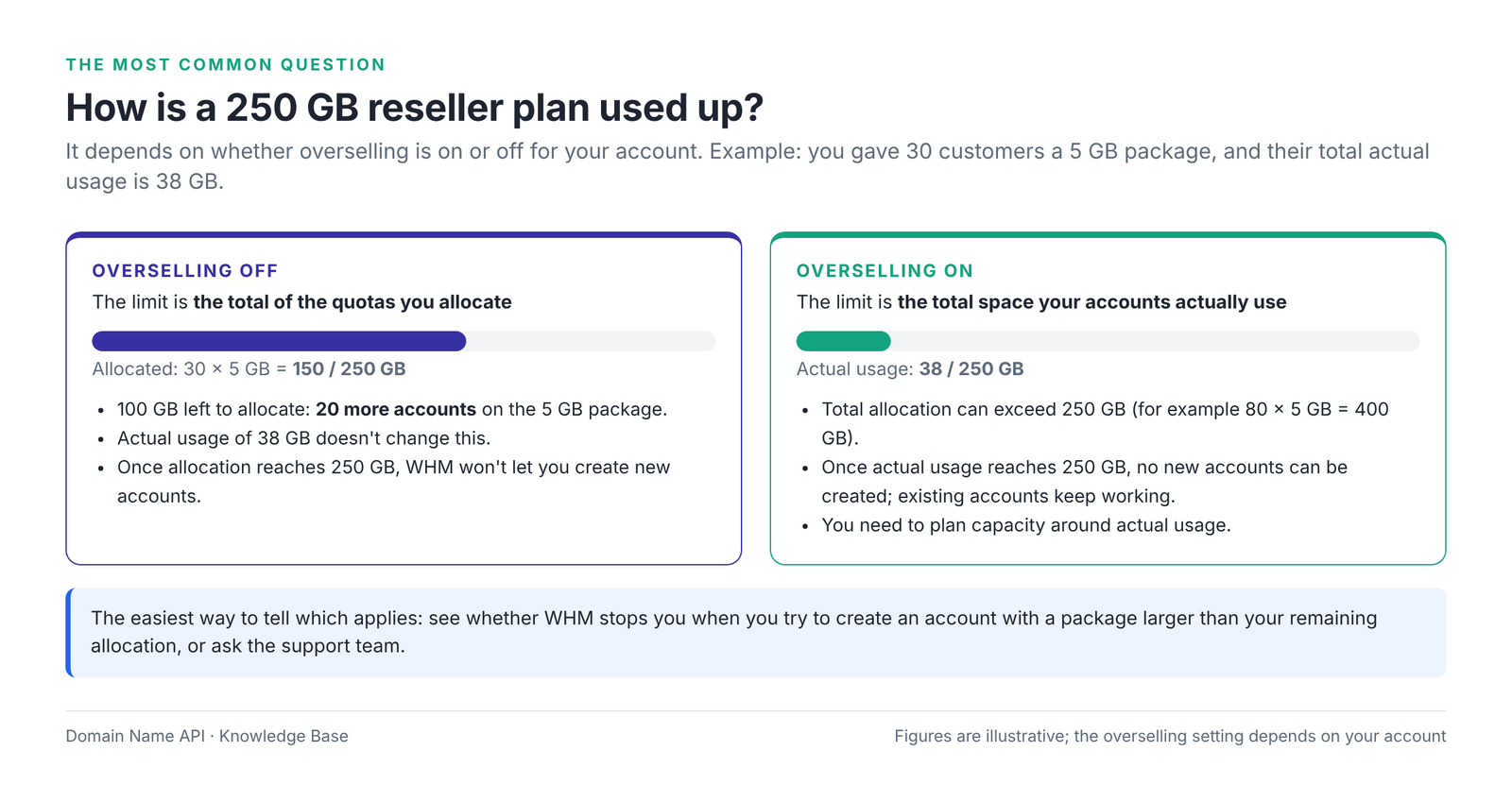
How a 250 GB reseller plan gets used up depends on whether overselling is on or off for your account. With overselling off, the limit is the total of the quotas you allocate to customers. With overselling on, the limit is the total space your accounts actually use. cPanel's own documentation defines the two behaviors this way.
| Question | If overselling is off | If overselling is on |
|---|---|---|
| What does 250 GB limit? | The total of the quotas you hand out through packages | The total actual disk usage of your accounts |
| Can I give 100 customers a 5 GB package? (500 GB) | No. After 50 accounts your allocation reaches 250 GB and WHM won't create more | Yes. You can create accounts until total actual usage reaches 250 GB |
| A customer uses only 1 GB of a 5 GB package? | It still takes up 5 GB of your capacity | Only 1 GB comes off your capacity |
| What happens at the limit? | You can't create new accounts; existing accounts keep working | You can't create new accounts; existing accounts keep working |
| Can I create packages with unlimited quota? | Usually not; the allocation can't be calculated | Depends on your reseller privileges |
| What's the risk? | Capacity looks used up before it's actually used | Total allocation exceeds capacity; if customers fill their quotas, space runs out |
What counts towards capacity: reseller capacity covers the usage or allocation of every cPanel account you own. If you opened a cPanel account under your reseller account for your own site, that's included too. Everything in a cPanel account's home directory counts towards that account's disk usage: website files, email, logs and backup archives downloaded into the account. Whether databases count towards the disk quota depends on server configuration.
Which applies to your account?
Your overselling setting and reseller capacity are in your service details. If you're unsure, ask our support team. A practical sign: if WHM stops you when you try to create an account with a package larger than your remaining allocation, overselling is off.
A defined limit and actual usage aren't the same thing
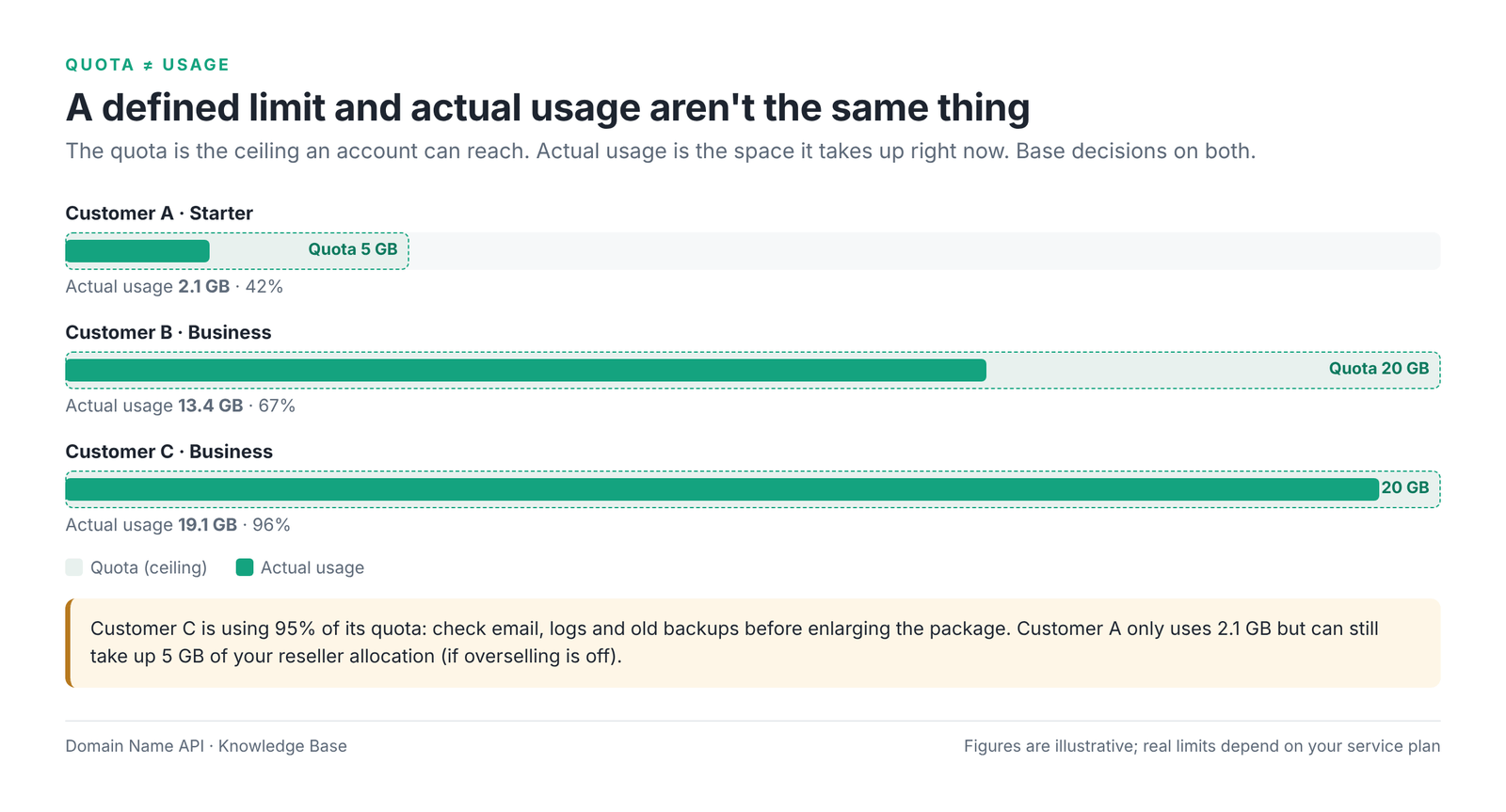
A package quota is the ceiling a customer can reach; actual usage is the space it takes up right now. A customer on a 20 GB package might be using 2 GB, or 19 GB. Base capacity, upgrade and pricing decisions on both.
| Term | Meaning | Where to see it |
|---|---|---|
| Package quota | The ceiling an account can reach | WHM › Packages; the quota column in List Accounts |
| Actual usage | Space the account takes up, or data it transfers, right now | WHM › List Accounts; cPanel › Disk Usage |
| Reseller allocation | The total of the quotas you've given all accounts | Compare with your reseller capacity |
| Reseller usage | The total actual usage of all accounts | Add up the usage values in List Accounts |
Where do I see customer resources in WHM?
In reseller WHM you track customer accounts' disk and bandwidth usage in the account list, the bandwidth table and the list of accounts over quota. Whether these screens appear depends on your reseller privileges; screens that belong to the server administrator aren't in reseller WHM.
| WHM screen | What you see | Which problem it solves | Which value to watch |
|---|---|---|---|
| Account Information › List Accounts | Each account's domain, username, package, disk quota and usage | Which customer uses how much space? | Usage/quota ratio; accounts over 80% |
| Account Information › Show Accounts Over Quota | Accounts that have exceeded their disk quota | A customer can't upload files or receive email | Every account in the list |
| Account Information › View Bandwidth Usage | Each account's bandwidth usage this month | A site transfers a lot of data through traffic or bots | Accounts close to the limit mid-month |
| Packages › Add / Edit a Package | Package limits | Which limits to give a new customer? | Disk, bandwidth and count limits |
| Account Functions › Upgrade/Downgrade an Account | Moving an account to another package | When a customer's package isn't enough | The target package's limits |
| Account Functions › Modify an Account | Changing one account's limits individually | A temporary or custom limit | Account-specific values |
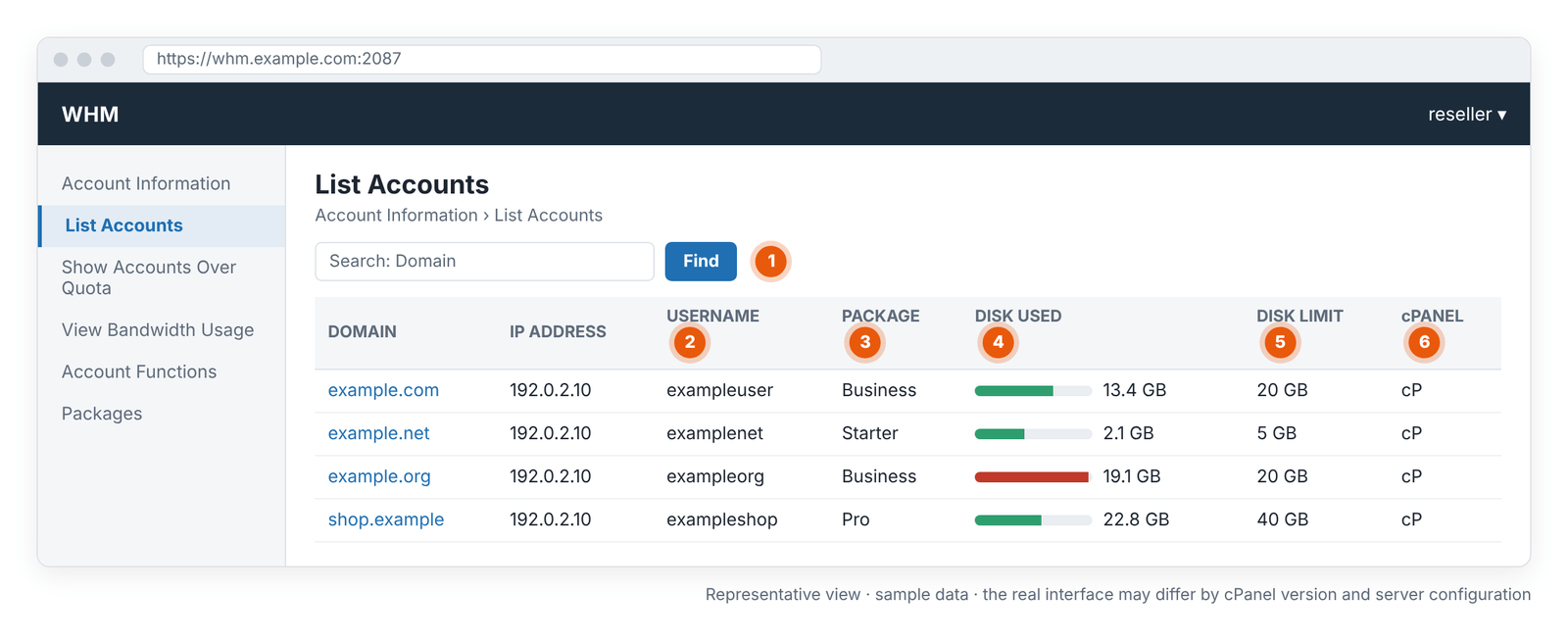
- 1 · Search: find an account by domain or username.
- 2 · Username: the cPanel username a support ticket asks for.
- 3 · Package: the package the account is on.
- 4 · Disk Used: actual usage; a red bar marks an account close to its quota (example.org at 96% here).
- 5 · Disk Limit: the package quota.
- 6 · cP: switch to the account's cPanel.
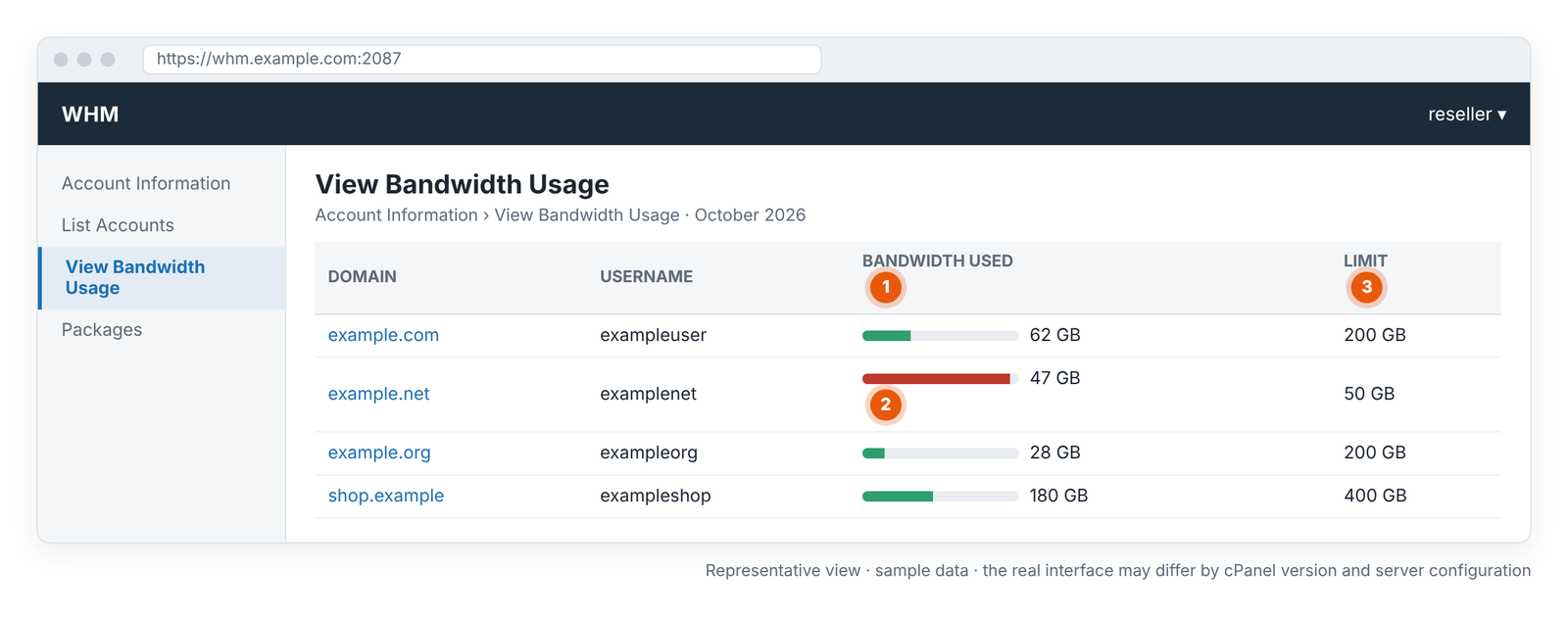
- 1 · Bandwidth Used: data transferred this month.
- 2 · An account close to its limit: example.net here, at 47 GB of a 50 GB limit.
- 3 · Limit: the monthly bandwidth in the package.
The Resource Usage screen in cPanel and the CPU, RAM and I/O metrics
cPanel › Metrics › Resource Usage shows, on servers that use CloudLinux LVE, how close a cPanel account is to its CPU, physical memory, I/O, IOPS, Entry Processes and process limits, and which limit it hit recently. If the screen opens with a warning such as "your account was limited within the last 24 hours", the details show which metric reached its limit.
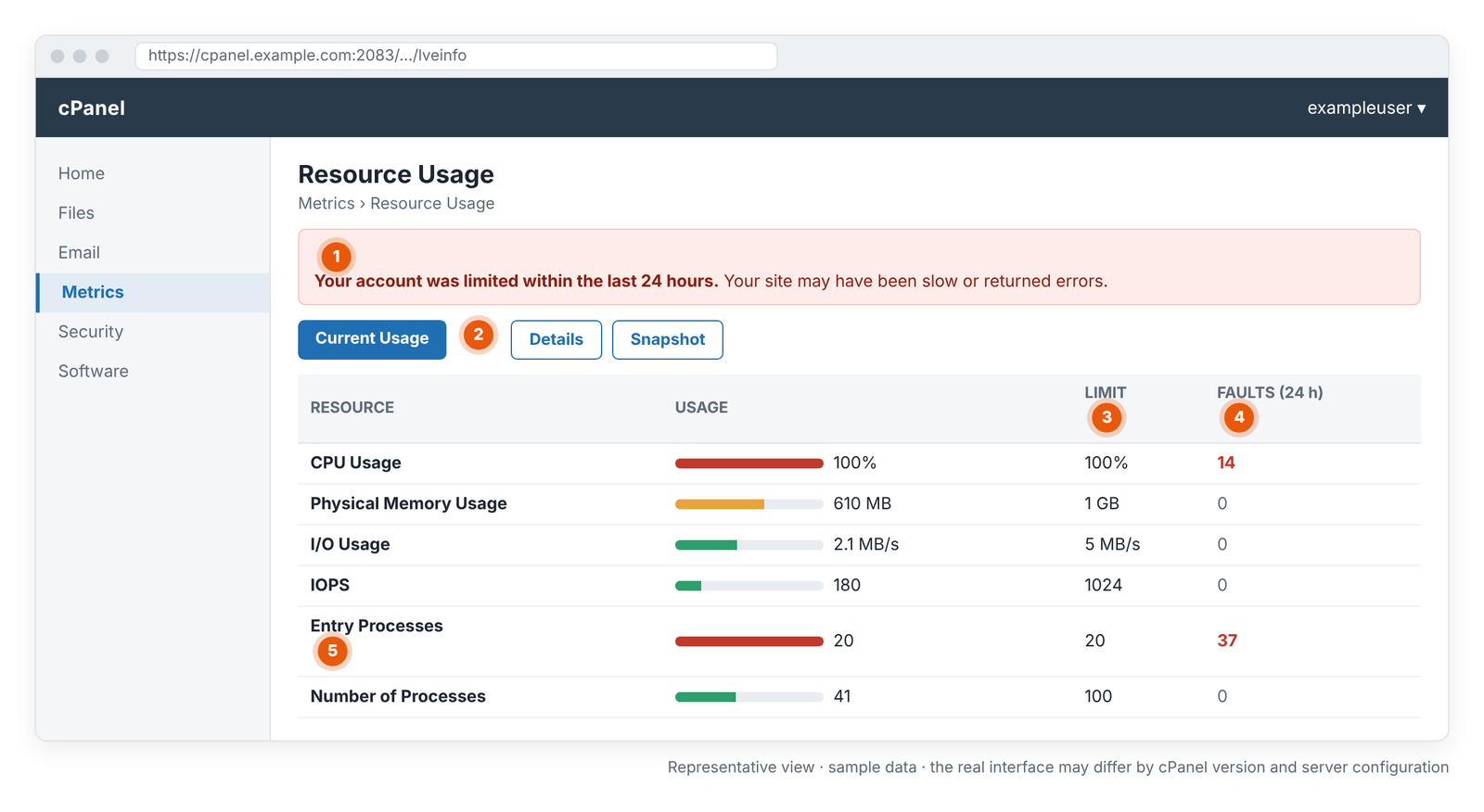
- 1 · Limit warning: appears if the account hit a limit in the last 24 hours.
- 2 · Current Usage / Details / Snapshot: current usage, history charts and the process list at the moment the limit was hit (tab names can vary by version).
- 3 · Limit: the limit set for the account.
- 4 · Faults: how many times the limit was hit. This is the most important column for diagnosis.
- 5 · Entry Processes: 20/20 with 37 faults here; visitors saw 508 errors at the time.
What does CPU 100% mean?
The CPU percentage in Resource Usage is shown against the CPU limit allocated to your account; it doesn't show the whole server's CPU. In CloudLinux the CPU limit is defined in cores (100% = one core). Seeing "CPU 100%" means your site is using all of its own share, not that the server is full.
| Metric | What it means | At the limit | Does a one-off matter? | If it's constant, what to do |
|---|---|---|---|---|
| CPU Usage | Share of the processor power allocated to the account in use | The site doesn't stop, it slows down (throttled) | Normal during backups or imports | Check caching, plugins, cron and bot traffic |
| Physical Memory | Real RAM used by the account's processes | Some processes are killed; 500/503 errors | Can happen once; investigate if it repeats | Review heavy plugins, large queries and the PHP memory setting |
| I/O Usage | Amount of data read from and written to disk per second | Disk operations wait; the site slows down | Expected when extracting large archives or backing up | Move big jobs to quiet hours; cut unnecessary log writing |
| IOPS | Number of read/write operations per second | Operations wait until that second ends | Seen when working with many small files | Clear cache and session files; review file-based caching |
| Entry Processes | Dynamic request processes entering the account through the web server at the same time | New requests are rejected with a 508 error | Can appear at a short traffic peak | Investigate slow PHP requests, bot traffic and caching |
| Processes (NPROC) | All processes running in the account at once | No new process can start; 500/503 errors | Seen with stuck cron jobs or scripts | Check stuck processes and cron jobs that run too often |
What happens when a cPanel resource limit is exceeded?
Each limit behaves differently when it's hit: at the CPU and I/O limits the site slows but stays up; at the memory, process and Entry Processes limits requests return errors; at the disk quota writing stops; at the bandwidth limit the site may show a warning page. Matching the symptom to the right limit is half the diagnosis.
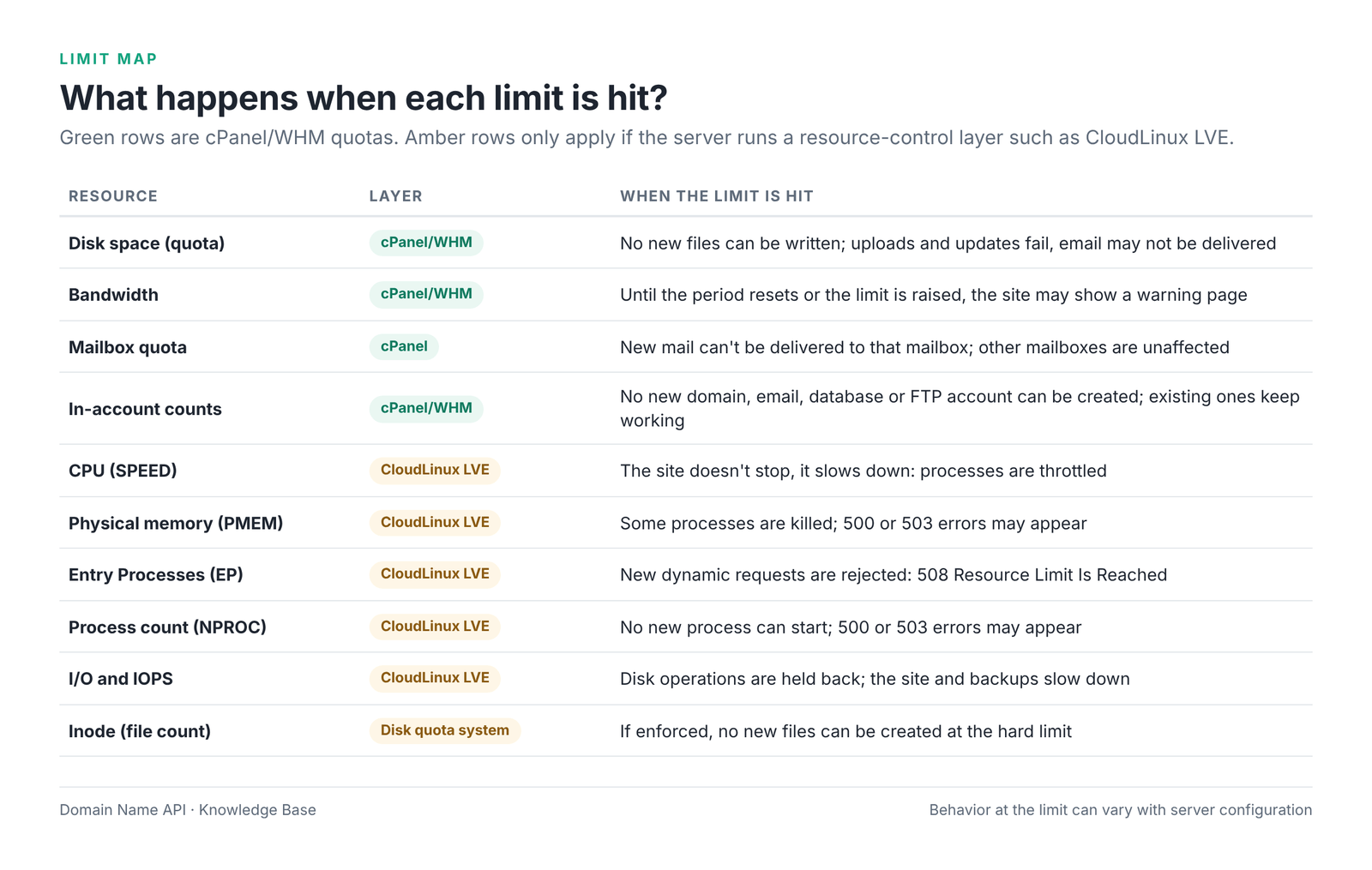
- Disk quota full: no new files can be written; WordPress updates, file uploads and cache creation fail. The account's email can be affected too.
- Mailbox quota full: new mail can't be delivered to that mailbox only; the sender usually gets a bounce message.
- Bandwidth used up: until the period resets or the limit is raised, cPanel may show a warning page instead of the site. Email usually isn't affected by this limit.
- In-account count limits reached: no new email, database, domain or FTP account can be created; existing ones keep working.
- CPU or I/O limit reached: the site doesn't error out; it slows down.
- Physical memory or process limit reached: some requests end with a 500 or 503 error.
- Entry Processes limit reached: new requests get "508 Resource Limit Is Reached".
What do "Resource Limit Is Reached" and the 508 error mean?
"Resource Limit Is Reached" doesn't mean your disk is full. On CloudLinux servers the 508 error appears most often when the Entry Processes limit is reached; similar slowdowns and errors can also come from the CPU, physical memory, process or I/O limits. You see which limit was hit in the Resource Usage screen.
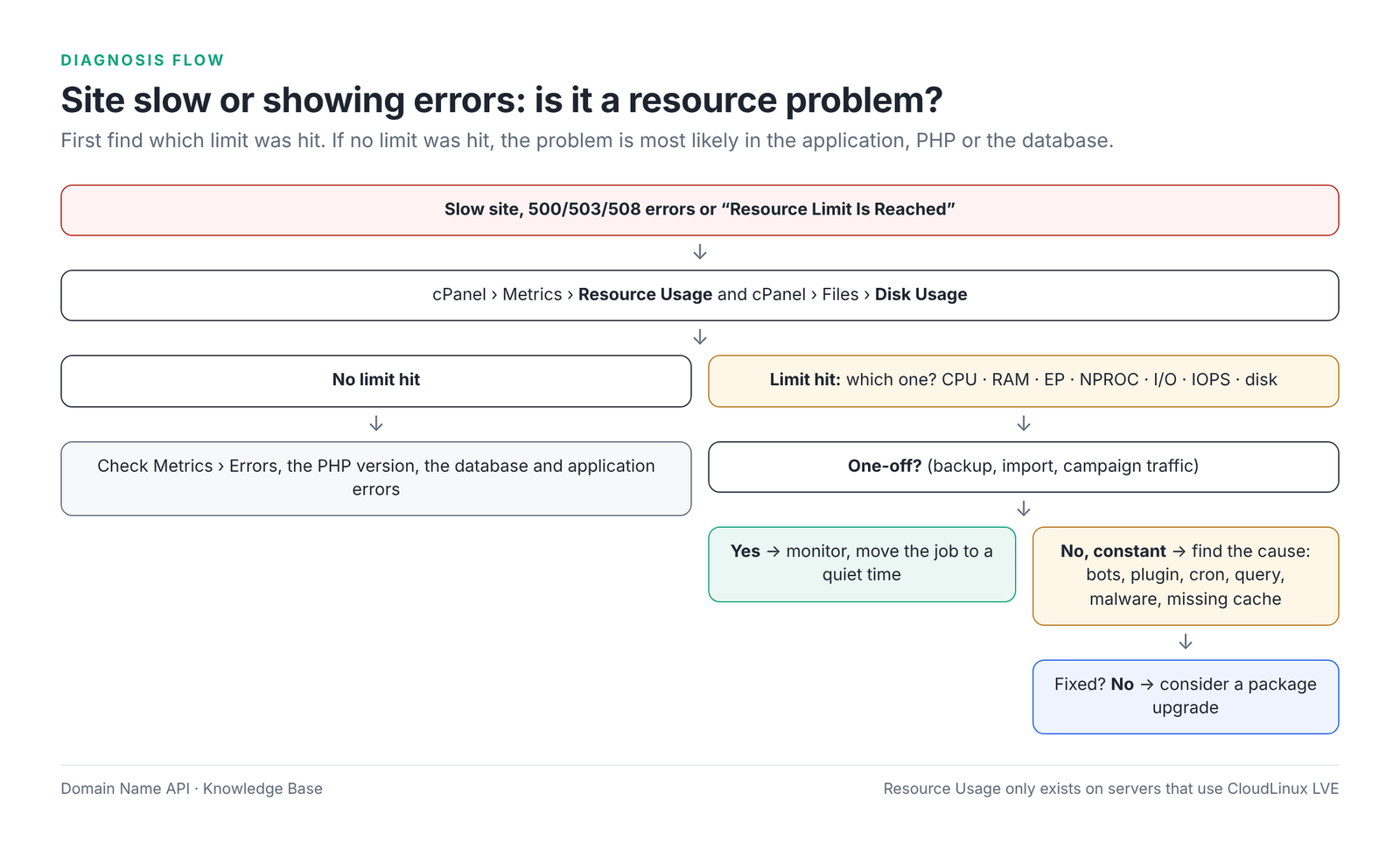
- Open cPanel › Metrics › Resource Usage.
- Check whether the account was limited in the last 24 hours and which metric reached its limit in the details.
- Note the times the limit was hit. If they line up with a backup, import, campaign or cron job, the problem is one-off.
- If it's constant and repeats through the day, check the access logs (cPanel › Metrics › Raw Access or Visitors) and error logs (Errors) for the same times: heavy bot traffic, a single slow page or a failing plugin usually shows up here.
- After fixing the cause, watch Resource Usage for a few days. If the account keeps hitting the limit, consider a package upgrade.
What should you do when CPU usage is high?
CPU briefly reaching its limit doesn't on its own mean the package is too small. If the same limit is hit again and again through the day, first find which process is creating the load.
| Possible cause | How to recognize it | First action |
|---|---|---|
| Real traffic growth | Visitor stats and CPU rise at the same times | Page caching; upgrade if it's measurable and lasting |
| Bots and crawlers | Many requests from the same IP or user agent in the access log | robots.txt, bot blocking, CDN or WAF rules |
| A heavy WordPress plugin | Usage drops when the plugin is disabled | Replace the plugin or simplify its settings |
| Cron jobs | Peaks that repeat at certain minutes | Run them less often; in WordPress use a system cron instead of wp-cron |
| Slow database query | Some pages are slow, others fast | Optimize the query or plugin; repair tables |
| Malware | Unknown files, unexpected outgoing email | Scan and clean; change passwords |
| Backup, import/export | The peak happens exactly during that job | Move it to quiet hours; monitor if it's one-off |
| No caching | Every page request goes to PHP and the database | Page and object caching |
What should you do when physical memory (RAM) usage is high?
When the physical memory limit is reached, some PHP processes are killed; visitors see this as a 500 or 503 error, a half-loaded page or a failed form submission.
| Step | What to do |
|---|---|
| Symptom | Intermittent 500/503 errors, admin tasks that stop halfway |
| Likely cause | A heavy plugin or theme, a large import, a very high PHP memory_limit, many long-running requests at once |
| Where to check | cPanel › Metrics › Resource Usage (physical memory details) and Metrics › Errors |
| First action | Find the job running when the limit was hit; disable the heavy plugin and test; split large jobs into smaller ones |
| When to upgrade | If the application is lean and cached and still hits the memory limit regularly under normal traffic |
What are Entry Processes, and why aren't they visitor numbers?
Entry Processes aren't the number of visitors on your site at once. In CloudLinux they limit the number of dynamic request processes entering the account through the web server at the same time. If each request finishes in milliseconds, hundreds of simultaneous visitors can be served with a low Entry Processes value; a single slow page can fill the limit with only a few visitors.
- "20 Entry Processes = 20 visitors at once" isn't right. What matters is how long requests take to finish.
- Static files (images, CSS) and pages served from cache usually don't add to this limit; heavy PHP requests do.
- If the limit fills up constantly, find the slow requests first: long-running admin tasks, external API calls that time out, search or filter pages being crawled by bots.
What's the difference between I/O and IOPS?
I/O measures how much data is read from and written to disk per second (the amount); IOPS measures how many separate read/write operations happen per second (the count). When either limit is reached, operations wait and the site slows, but different jobs push each limit.
| I/O | IOPS | |
|---|---|---|
| What it measures | Amount of data per second | Number of operations per second |
| Which jobs push it | Creating a large backup archive, extracting a large ZIP, copying big files | Many small files: cache files, session files, mail folders, thousands of image thumbnails |
| At the limit | Disk operations slow down | Operations wait until that second ends |
| First action | Move big jobs to quiet hours | Clean up unneeded small files; limit file-based caching |
How do you check disk usage in cPanel?
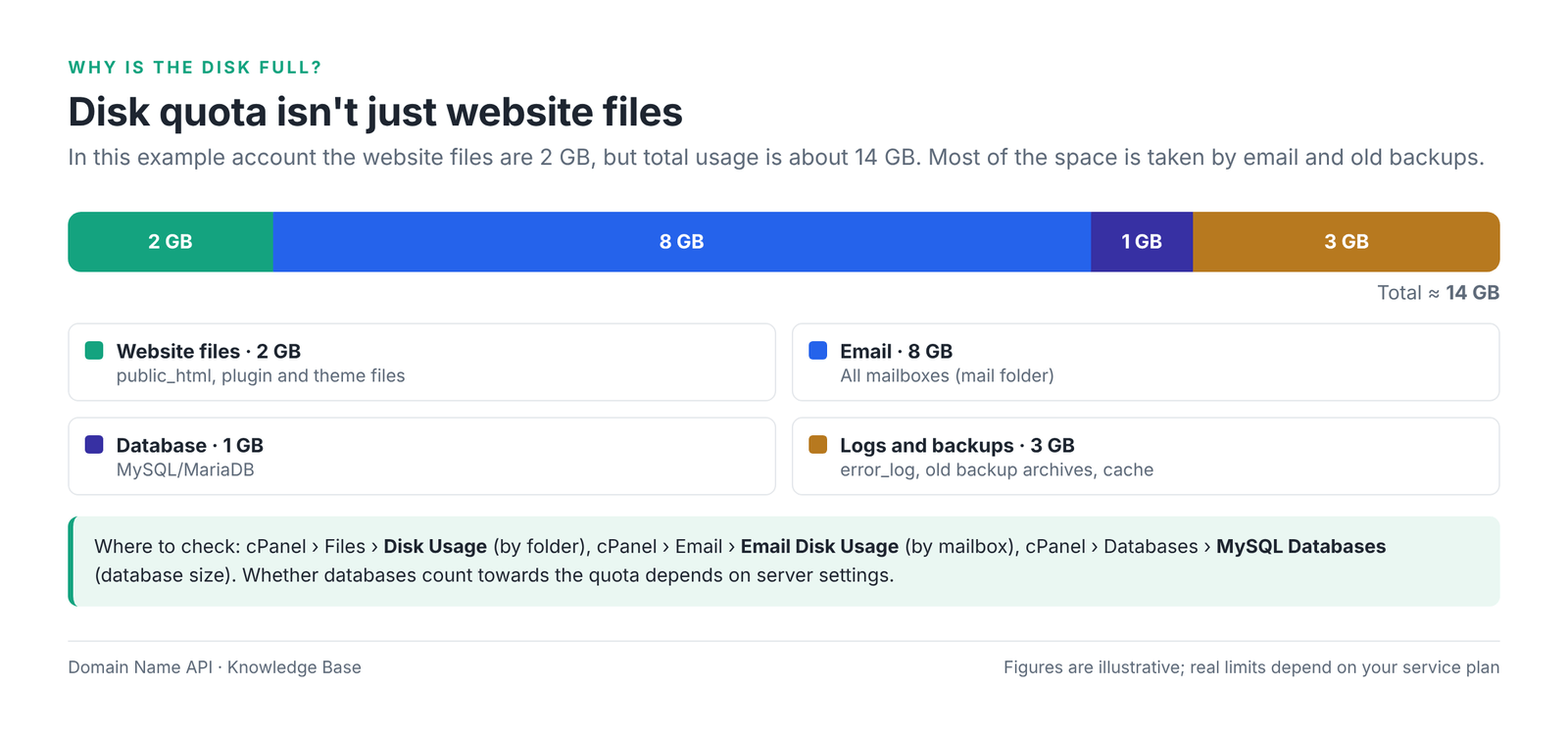
You see disk usage by folder in cPanel › Files › Disk Usage. If the disk quota looks full, don't only look at public_html: email, databases, log files and old backups forgotten inside the account can take up a lot of space.
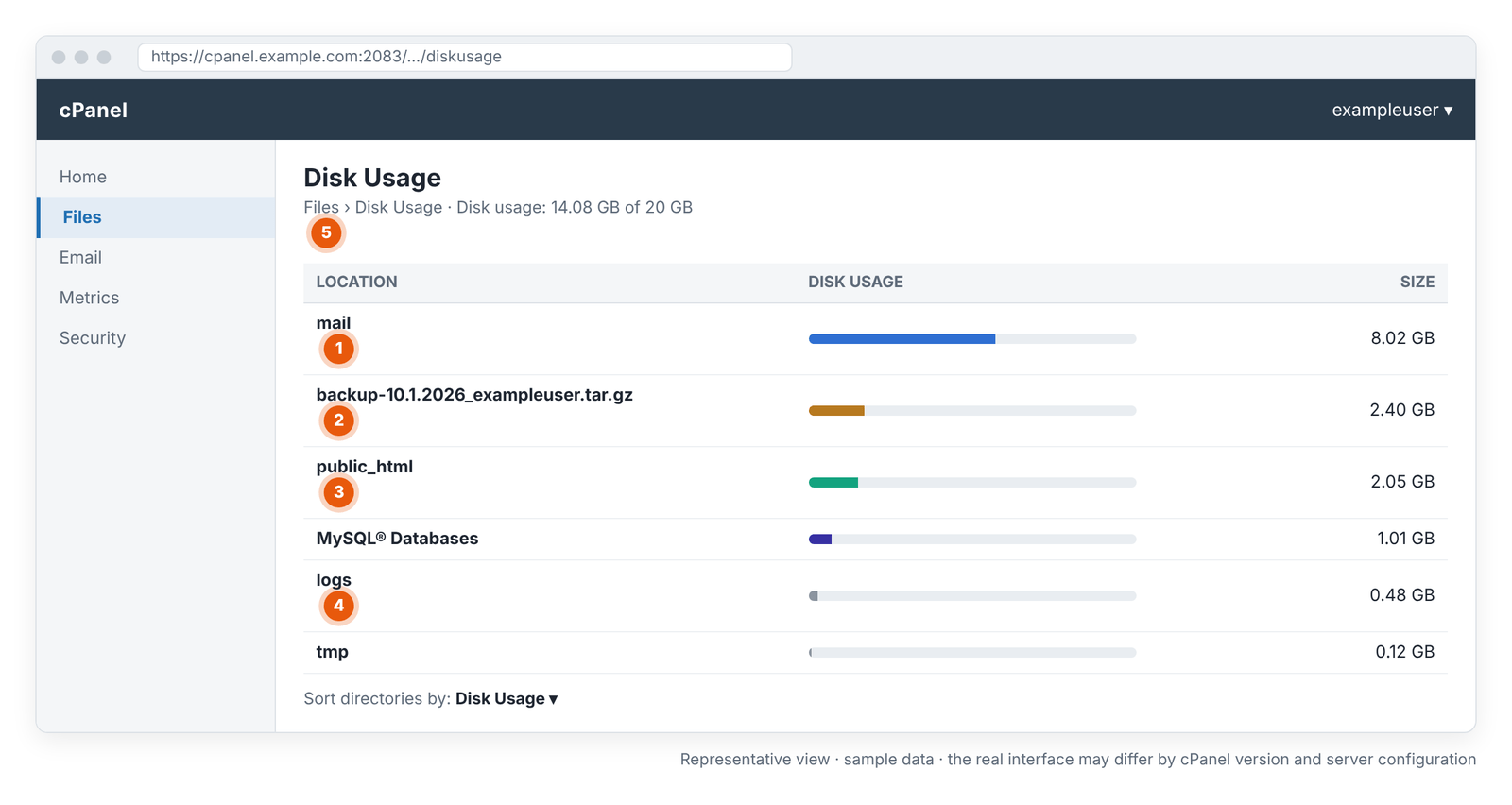
- 1 · mail: mailboxes; more than half the space in this example.
- 2 · backup-….tar.gz: a backup archive forgotten in the home directory.
- 3 · public_html: website files; often smaller than people expect.
- 4 · logs: access and error logs.
- 5 · Total: the account's usage and quota.
| Where to look | What you'll find |
|---|---|
| cPanel › Files › Disk Usage | Usage by folder; the fastest way to find large folders |
| cPanel › Email › Email Disk Usage | Mailbox sizes; deleting old mail by date |
| cPanel › Databases › MySQL Databases | Database sizes |
| File Manager › home directory | Old backup archives such as backup-*.tar.gz, large error_log files, cache folders |
The example in the figure is illustrative: an account with 2 GB of website files can use 14 GB in total because of email and old backups. Whether databases count towards the disk quota depends on server settings; Disk Usage shows databases on a separate row.
Why does the inode (file count) matter?
An inode is the record kept for every file and folder in the account; the count shows how many files there are. If a file count limit is enforced on your account, a large number of small files can stop new files being created even when disk space is free, and it slows down backups and migrations. You can tell whether the limit is enforced by whether a "File Usage" style row appears in the statistics on the cPanel home screen.
- The biggest file count drivers: cache folders, PHP session files, mail folders, backup archives extracted and never deleted, old log rotations.
- Turn on your caching plugin's cleanup setting and delete installations you no longer use.
How does bandwidth usage work?
Bandwidth isn't internet speed; it's the total amount of data transferred from your site in a period (usually a month). When the monthly limit is used up, the site may show a warning page until the period resets or the limit is raised.
There's no exact formula such as "100 GB = this many visitors". Page size, image optimization, caching, CDN use, downloadable files and bot traffic give very different results for the same number of visitors. Track bandwidth during the month in WHM › View Bandwidth Usage; a sudden jump usually points to bot traffic or large files linked directly.
| Disk space | Bandwidth | |
|---|---|---|
| What it measures | The size of the data stored in the account | The total data transferred in a period |
| When it resets | It doesn't; it goes down when files are deleted | At the start of each period |
| When it's full | Writing stops | The site may show a warning page |
How should you set hosting package limits for your customers?
Set package limits around the customer's site and email use; giving everyone the biggest package uses up your reseller capacity for nothing, and giving everyone the smallest leads to frequent support requests. The profiles below are illustrative; they aren't Domain Name API's official packages.
| Example profile | Who it's for | Disk quota | Monthly bandwidth | Domains / email / databases |
|---|---|---|---|---|
| Starter | Company brochure site, little email | 2–5 GB | 20–50 GB | 1 / 5–10 / 1–2 |
| Business | WordPress, medium traffic, team email | 10–20 GB | 100–200 GB | 3–5 / 25–50 / 5 |
| Pro | WooCommerce or a busy application | 20–40 GB | 200 GB and up | 5–10 / 50+ / 10 |
- Think about email separately: a small site with team email can fill far more space with mail than with website files.
- Leave an upgrade path: make the steps between packages meaningful so a growing customer can move up in one step with Upgrade/Downgrade.
- Don't promise CPU and RAM through packages: standard WHM packages don't have these fields. If the server runs CloudLinux, per-account limits are set on the server side; confirm any performance figures you give customers with our support team.
- If overselling is off, package quotas come straight off your reseller capacity; keep quotas close to real needs.
For the steps to create a package, see How to Create a Package in WHM.
How many customers can I host on my reseller plan?
There's no single right number; customer count isn't a good measure of capacity. Ten busy WooCommerce sites can use more resources than a hundred low-traffic company sites. If your service plan has an account limit, that's the ceiling on how many accounts you can create, even if your resources would stretch further.
Assess your capacity with these questions:
- Disk: what percentage of your reseller limit is your total allocation (overselling off) or total actual usage (overselling on)?
- Bandwidth: what percentage of your reseller limit have your accounts used this month, and where will it be by month end?
- Account count: how far are you from the account limit in your service plan?
- Resource Usage (if present): which accounts regularly hit the CPU, memory or Entry Processes limit?
- Application type: how many accounts are online shops, and how many are static sites?
- Email: which customers use email heavily?
As a practical rule, it's a good habit to review capacity before new sales once total disk and bandwidth usage reaches about 80% of your reseller limit.
What is overselling in WHM?
Overselling means the reseller limit is applied to the resources accounts actually use rather than to the quotas allocated to customers. With overselling on, you can hand out more quota in total than your reseller capacity; once total actual usage reaches your limit, you can't create new accounts. With overselling off, once the total of the quotas you've handed out reaches your limit, you can't create new accounts, whatever the actual usage.
| Overselling off | Overselling on | |
|---|---|---|
| What the limit applies to | Allocated quotas | Actual usage |
| Advantage | The space you give each customer is guaranteed | You use capacity more efficiently |
| Risk | Capacity looks used up before it's used | If customers fill their quotas, capacity runs out |
| What to do | Keep quotas close to real needs | Track total usage regularly |
As a reseller you can't change the overselling setting yourself; our support team can tell you how it's set on your account.
Do I need to upgrade?
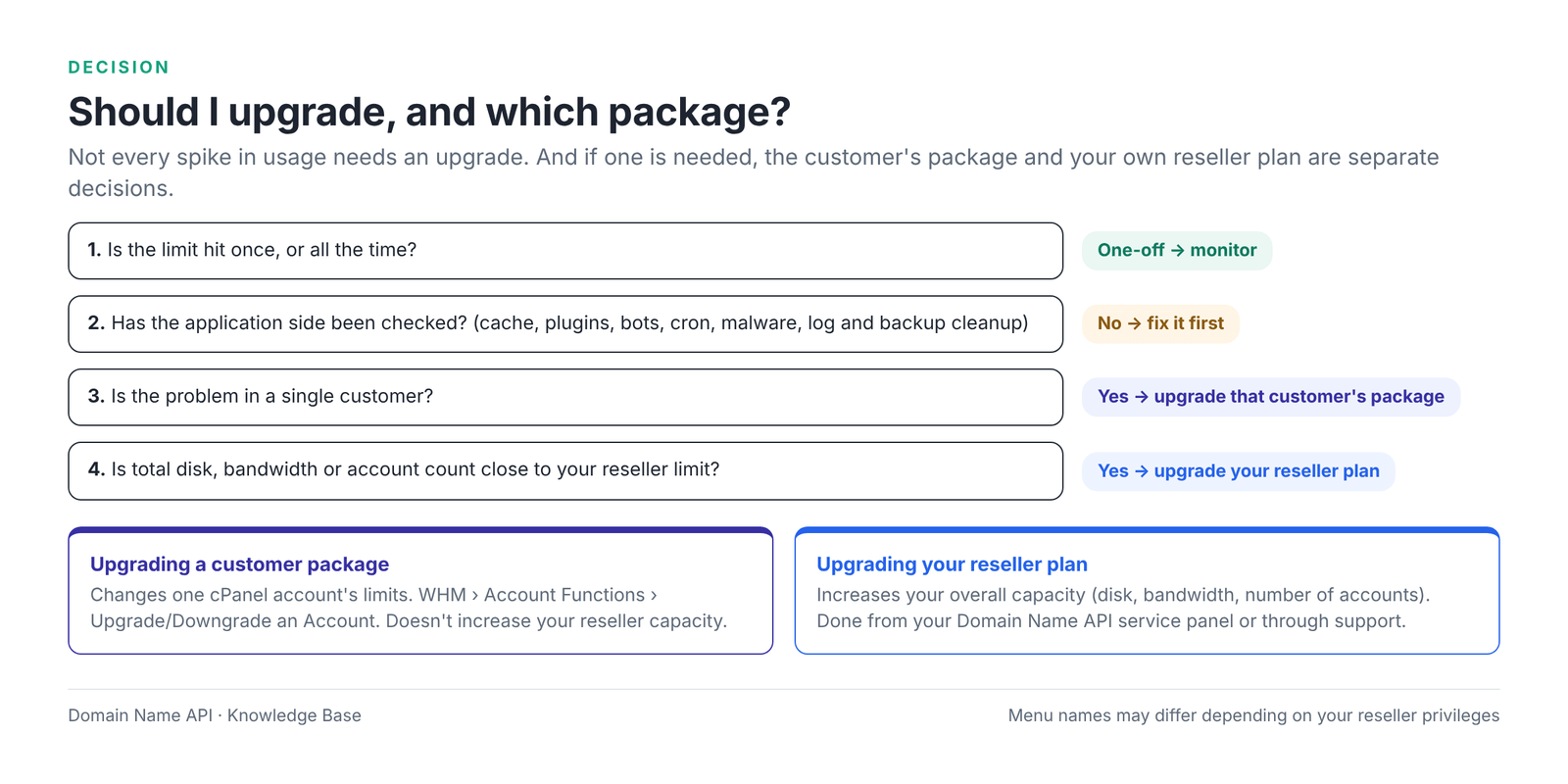
Not every spike in resource usage needs a package upgrade. The cause is often a broken plugin, bot traffic, a cron job stuck in a loop, malware or missing caching. An upgrade is the right call when the same limit keeps being hit regularly after the application side has been fixed.
How do you move a customer to a bigger package?
- In WHM, open Account Functions › Upgrade/Downgrade an Account.
- Select the customer account from the list.
- Choose the new package and save.
- Check in WHM › List Accounts that the account shows its new package and quota.
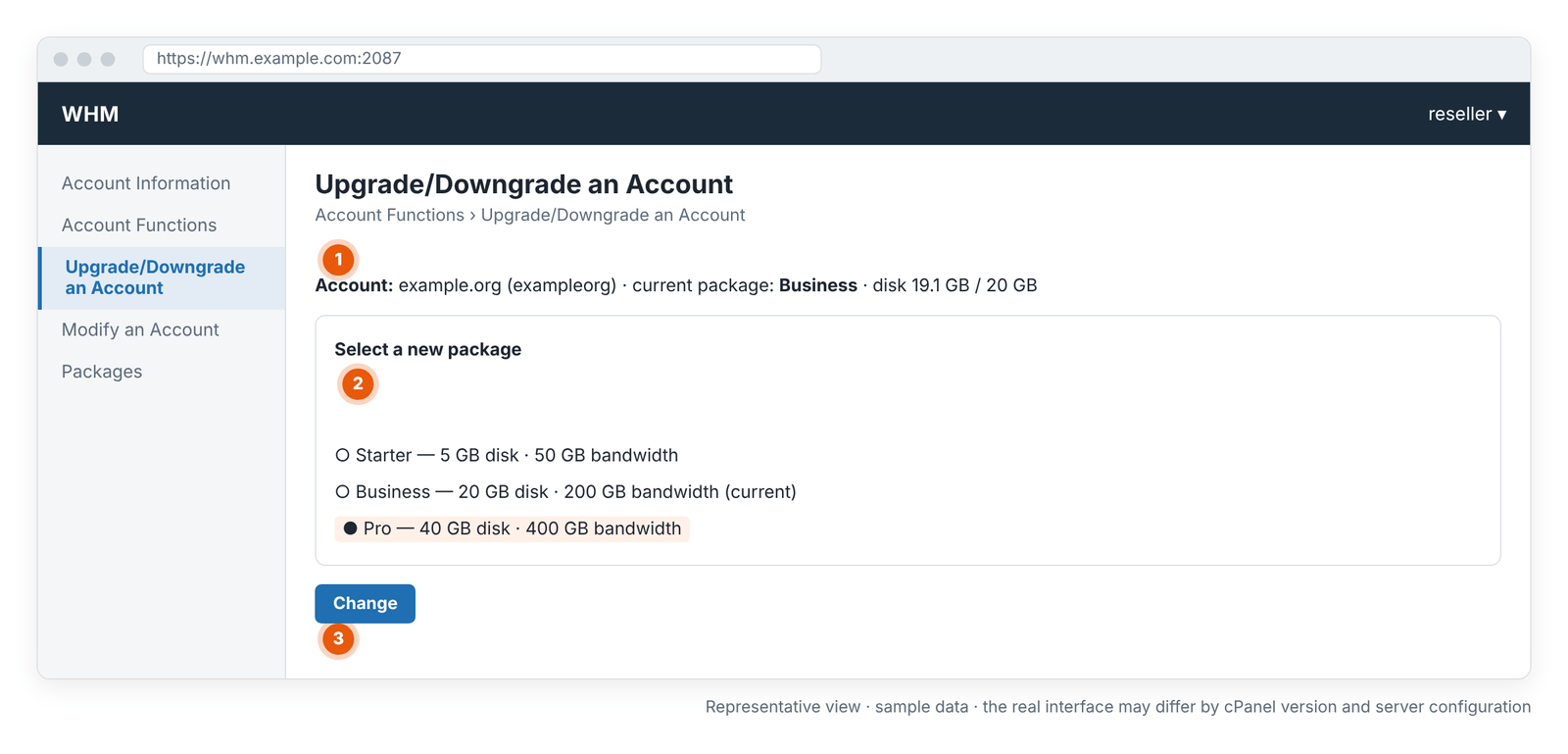
- 1 · Account: the account to move and its current package.
- 2 · New package: the target package's limits; if overselling is off, the difference comes off your reseller allocation.
- 3 · Change: applies the move.
- What changes with the package? The account's disk quota, bandwidth and count limits switch to the new package's values.
- Account-specific changes: if you earlier gave the account a custom value with Modify an Account, expect the package change to replace it with the new package's value. Reapply the custom value after the change if you still need it.
- Editing a package: if you change a package's limits in WHM › Packages › Edit a Package, every account using that package is affected. Don't edit a package for one customer; move that customer to another package.
- If overselling is off: moving to a bigger package uses up your reseller allocation by the difference. If your remaining allocation isn't enough, the move won't go through.
Upgrading a customer package vs upgrading your reseller plan
Upgrading a customer package changes the limits of one cPanel account; upgrading your reseller plan increases your overall capacity. One doesn't replace the other.
| Customer package upgrade | Reseller plan upgrade | |
|---|---|---|
| What it changes | One cPanel account's limits | Your total disk, bandwidth and number of accounts |
| Where it's done | WHM › Upgrade/Downgrade an Account | Your Domain Name API service panel or the support team |
| When | A customer keeps hitting their own quota | Total usage or allocation is close to your reseller limit |
| What it doesn't do | Doesn't increase your reseller capacity | Doesn't enlarge any customer's quota by itself |
Real-world scenarios
Scenario 1 — One account's disk is 95% full
Symptom: The customer can't upload images; WordPress updates stop halfway.
Diagnosis: List Accounts shows 95% usage. In Disk Usage the mail folder and old backup archives in the home directory are large.
Right action: Download old backups to your computer and delete them, clean old mail from large mailboxes, empty the error_log files.
Is an upgrade needed? If it's still above 80% after cleanup, upgrade the customer's package.
Scenario 2 — CPU constantly hits its limit
Symptom: The site is slow all day; Resource Usage shows CPU limiting every day.
Diagnosis: Thousands of requests from the same user agent in the access logs; no caching plugin.
Right action: Block the bot traffic, turn on page caching and watch for a few days.
Is an upgrade needed? Yes, if it continues under normal traffic after caching and bot blocking.
Scenario 3 — CPU only rises during backups
Symptom: CPU and I/O limits are hit at the same time every night.
Diagnosis: The peak matches the time a plugin backup runs.
Right action: Move the backup to a quiet hour; if possible switch to a method that only backs up changed files.
Is an upgrade needed? No. It's a one-off, predictable load.
Scenario 4 — Entry Processes constantly reach the limit
Symptom: Visitors sometimes see a 508 error.
Diagnosis: The error logs show an external API call timing out; slow requests stay open for a long time.
Right action: Shorten the timeout or cache the API call; block bots from filter and search pages.
Is an upgrade needed? In most cases, no; the problem is how long requests take.
Scenario 5 — Website files are small but the disk is full
Symptom: public_html is 1.5 GB, but the account has filled its 10 GB quota.
Diagnosis: Email Disk Usage shows two mailboxes totaling 7 GB; a 1 GB old backup sits in the home directory.
Right action: Plan archiving old mail with the customer and delete the old backup.
Is an upgrade needed? If the email usage is lasting, move to a package with a larger disk quota.
Scenario 6 — Your reseller capacity is filling up, but one customer uses most of it
Symptom: A capacity warning when creating a new account.
Diagnosis: In List Accounts one account makes up half of total usage.
Right action: Look into that account's usage and talk to the customer; if needed, move them to a bigger package and price it accordingly.
Is an upgrade needed? If you need room for other accounts too, upgrade your reseller plan; otherwise sort out that account first.
cPanel resource usage problems and fixes
| Problem | Possible cause | Where to check | What to do |
|---|---|---|---|
| Resource Limit Is Reached | Entry Processes or another LVE limit was hit | Resource Usage | Find which limit was hit; follow the diagnosis flow |
| 508 Resource Limit Is Reached | Entry Processes limit was hit | Resource Usage | Find slow requests and bot traffic; turn on caching |
| CPU limit reached | Traffic, bots, plugin, cron, query | Resource Usage; access logs | Find the cause; caching and bot blocking |
| Physical memory limit reached | Heavy plugin, large import | Resource Usage; Errors | Find and split the heavy job; test the plugin |
| Entry Processes limit reached | Long-running PHP requests | Resource Usage; Errors | Fix slow pages and external calls |
| I/O limit reached | Backup, large archive, heavy logging | Resource Usage | Move big jobs to quiet hours |
| Disk quota exceeded | Quota is full | List Accounts; Disk Usage | Clean up backups, logs and email; upgrade the package if needed |
| Bandwidth exceeded | Traffic, bots, large file downloads | View Bandwidth Usage | Block bots, move large files to a CDN; raise the limit temporarily |
| File count (inode) limit | Cache, session and mail files | cPanel statistics | Clear cache and old files |
| Mailbox full | Mailbox quota is full | Email Accounts; Email Disk Usage | Delete old mail or raise the mailbox quota |
| Database too large | Log tables, sessions and temporary data | MySQL Databases; phpMyAdmin | Clean unneeded tables; reduce the application's logging |
| Site very slow, no limit hit | Application, PHP version, external service | Errors; PHP settings | Check the error logs; check the PHP version and plugins |
| 503 Service Unavailable | Memory or process limit, PHP error | Resource Usage; Errors | Find which limit; check for stuck processes |
| Backups filled the disk | Backup archives piling up in the home directory | Disk Usage; File Manager | Download and delete archives; keep backups outside the account |
| error_log has grown huge | A PHP warning repeating constantly | File Manager | Fix the error, empty the file |
| Cache files have grown huge | Cleanup setting is off | Disk Usage | Clear the cache; turn on automatic cleanup |
| Reseller disk capacity is full | Allocation (overselling off) or usage (on) has hit the limit | List Accounts totals; service details | Close unused accounts, review quotas or upgrade your reseller plan |
| A customer account's quota is full | The account doesn't fit its package | List Accounts | Clean up or Upgrade/Downgrade |
| Can't create a new account | Reseller account count or disk allocation limit | The WHM error message; service details | Check remaining allocation; try a smaller package or upgrade your reseller plan |
| Can't assign a package | Package larger than remaining allocation, or a privilege limit | The WHM error message | Choose a smaller package or free up allocation |
| Limit didn't change after an upgrade | An account-specific value, or a stale page | Modify an Account; List Accounts | Check for an account-specific value; refresh the page |
| Resource Usage screen isn't shown | No CloudLinux LVE on the server, or the feature is off | cPanel › Metrics | Use the disk and bandwidth screens; open a ticket for CPU/RAM problems |
Common mistakes
| Mistake | Why it's wrong | The right approach |
|---|---|---|
| Reading CPU 100% as the whole server being full | The percentage is against the account's own share | Interpret it against the account's own limit |
| Reading Entry Processes as visitor numbers | It counts simultaneous request processes and depends on duration | Find the slow requests |
| Mixing up disk and bandwidth | One is stored data, the other transferred data | Look at the two screens separately |
| Mixing up package quota and actual usage | Quota is a ceiling, usage is the current state | Track both together |
| Mixing up a customer package and your reseller plan | One changes an account, the other your total capacity | Work out which level the problem is at |
| Upgrading for every performance problem | The cause is often in the application | Diagnose and optimize first |
| Only looking at public_html when the disk is full | Email, logs and backups take up a lot of space | Look at the whole of Disk Usage |
| Forgetting email | Mailboxes count towards the account quota | Check Email Disk Usage |
| Forgetting backup archives | Backups in the home directory fill the quota | Keep backups outside the account |
| Making a lasting decision from one day's peak | One-off jobs are normal | Watch for a few days |
| Looking for server administrator screens in reseller WHM | Those screens aren't in a reseller account | Work with the screens in reseller WHM |
| Promising CPU/RAM limits through packages | Standard WHM packages don't have these fields | Confirm performance figures with the support team |
When should I open a support ticket?
Do your own checks first; they reveal the cause of most resource problems. If the problem continues, or you hit a limit you don't have the privileges to change, open a support ticket.
- cPanel › Metrics › Resource Usage (if present)
- cPanel › Files › Disk Usage and Email Disk Usage
- cPanel › Metrics › Errors and the access logs
- The account's package and package limits (WHM › List Accounts)
- The account's quota and usage
- Recent changes: plugin, theme, update, new cron job
Include in the ticket: the domain, the cPanel username, which limit was hit, the date and time of the problem, the full error message, a Resource Usage screenshot, whether the problem is constant or intermittent, and the latest change made.
Frequently asked questions
Where can I see resource usage in cPanel?
Disk usage is in cPanel › Files › Disk Usage, and bandwidth in cPanel › Metrics › Bandwidth. CPU, physical memory, I/O and Entry Processes appear in cPanel › Metrics › Resource Usage if the server runs CloudLinux LVE. As a reseller, you track all customers' disk usage in WHM › List Accounts.
What does CPU 100% mean?
CPU 100% in Resource Usage means the account is using all of the CPU limit allocated to it; it doesn't mean the whole server is full. In CloudLinux, 100% equals one processor core. When this limit is reached the site doesn't error out; it slows down.
What is Physical Memory Usage?
Physical Memory Usage is the real RAM used by the PHP and other processes in your account. When the limit is exceeded, the system kills some processes and visitors may see 500 or 503 errors. If it happens often, check heavy plugins, large imports and the PHP memory setting.
What are Entry Processes?
Entry Processes are, in CloudLinux, the number of dynamic request processes entering your account through the web server at the same time. When the limit fills, new requests get a 508 Resource Limit Is Reached error. The value depends on how long requests take; a fast, cached site can handle high traffic with a low value.
Are Entry Processes the same as visitor numbers?
No. Entry Processes count dynamic requests being processed at the same moment, not visitors. When requests finish in milliseconds, many visitors can be served with a low value; a single slow page can fill the limit with only a few visitors. Reading "20 EP" as "20 visitors" is misleading.
What's the difference between I/O and IOPS?
I/O measures the amount of data read from and written to disk per second; IOPS measures the number of read/write operations per second. Creating a large backup archive or extracting a large ZIP pushes I/O. Working with many small cache, session or mail files pushes IOPS. At either limit, the site slows down.
What does Resource Limit Is Reached mean?
This message means your account has reached one of its CloudLinux resource limits; it doesn't mean the disk is full. It most often appears with code 508 because of the Entry Processes limit. Find which limit was hit in cPanel › Metrics › Resource Usage, then check slow requests, bot traffic and caching.
How do I fix 508 Resource Limit Is Reached?
First find the times the limit was hit in Resource Usage. Look at the access and error logs for those times to spot bot traffic, slow pages and external calls that time out. Turn on page caching and limit bots. If it continues under normal traffic after these fixes, consider a package upgrade.
What happens when the disk quota is full?
When the disk quota is full, the account can't write new files: uploads, updates and cache creation fail, and email delivery can be affected. Existing pages usually still load. Free up space by checking email, log files and old backups in Disk Usage.
What happens when the bandwidth limit is used up?
When the monthly bandwidth limit is used up, cPanel may show a warning page instead of the site until the period resets or the limit is raised. Sudden jumps usually come from bot traffic or directly linked large files. As a reseller you can raise the account's limit temporarily or upgrade its package.
Does email count towards the disk quota?
Yes. Mailboxes in a cPanel account are kept in the account's home directory and count towards its disk quota. Each mailbox can also have its own quota. If website files are small but the disk is full, the first place to look is cPanel › Email › Email Disk Usage.
Do databases count towards the disk quota?
Whether databases count towards the cPanel disk quota depends on server configuration. Disk Usage shows databases on a separate row. You can see database sizes in cPanel › Databases › MySQL Databases and shrink them by cleaning unneeded log and session tables.
Do backup files count towards disk usage?
Every backup archive sitting in the account's home directory counts towards disk usage. Full backups created in cPanel for download and backups taken by plugins can fill the quota over time. After downloading backups to your computer or external storage, delete them from the account.
What is an inode in cPanel?
An inode is the record kept for every file and folder in the account and shows the number of files. On accounts with a file count limit, a large number of small files can stop new files being created even when disk space is free. Cache, session and mail files are the biggest inode drivers.
How many customers can I sell hosting to?
There's no single right number. If your service plan has an account limit, that's the ceiling; beyond that, disk, bandwidth and your customers' application types decide. Ten busy online shops can use more resources than a hundred small company sites. Review capacity when total usage reaches about 80% of your limit.
What's the difference between a package limit and actual usage?
A package limit is the ceiling a customer can reach; actual usage is the space they're using or the data they're transferring right now. A customer on a 20 GB package might use 2 GB, or 19 GB. With overselling off, the package limit comes off your reseller capacity; with it on, the actual usage does.
What is overselling?
Overselling means the reseller limit applies to accounts' actual usage rather than to the quotas handed out. With it on, you can hand out more quota in total than your capacity; once actual usage reaches the limit, you can't create new accounts. With it off, the total of the quotas you've handed out is your limit. Our support team can tell you your setting.
How do I upgrade my customer's package?
In WHM › Account Functions › Upgrade/Downgrade an Account, select the customer's account and the new package and save. The account's disk, bandwidth and count limits switch to the new package's values. If you gave the account custom values earlier, check them after the change.
When should I upgrade my reseller plan?
Upgrade your reseller plan when your total disk or bandwidth usage (or, with overselling off, your total allocation) gets close to your reseller limit, or when you reach the account limit. One customer's resource problem doesn't need a reseller plan upgrade; changing that customer's package is enough.
Should I upgrade as soon as CPU goes up?
No. Short CPU peaks are normal during backups or imports. If it's constantly high, first check bot traffic, plugins, cron jobs and caching. If the same limit keeps being hit regularly under normal traffic after these fixes, consider an upgrade.
Related guides
- First Login to Your Reseller Package: How to Access WHM
- How to Create a Package in WHM
- How to Create a Customer Account in WHM
- How to Restore a Backup in cPanel
- How to Migrate a Website to cPanel Reseller Hosting
Do your hosting accounts keep hitting resource limits?
Open a ticket with our support team. Include the domain, the cPanel username, the limit type, the date and time, the error message and a Resource Usage screenshot.
Open a Support TicketSell hosting under your own brand
Explore cPanel Reseller Hosting packages to sell hosting under your own brand.
Explore cPanel Reseller Hosting